Middle East Labs Trading (MIDLAB) supplies genuine Matest rebound hammer test equipment in Kuwait — a fast, non-destructive method to estimate concrete surface hardness and uniformity on site.
What the Rebound Hammer Test Measures
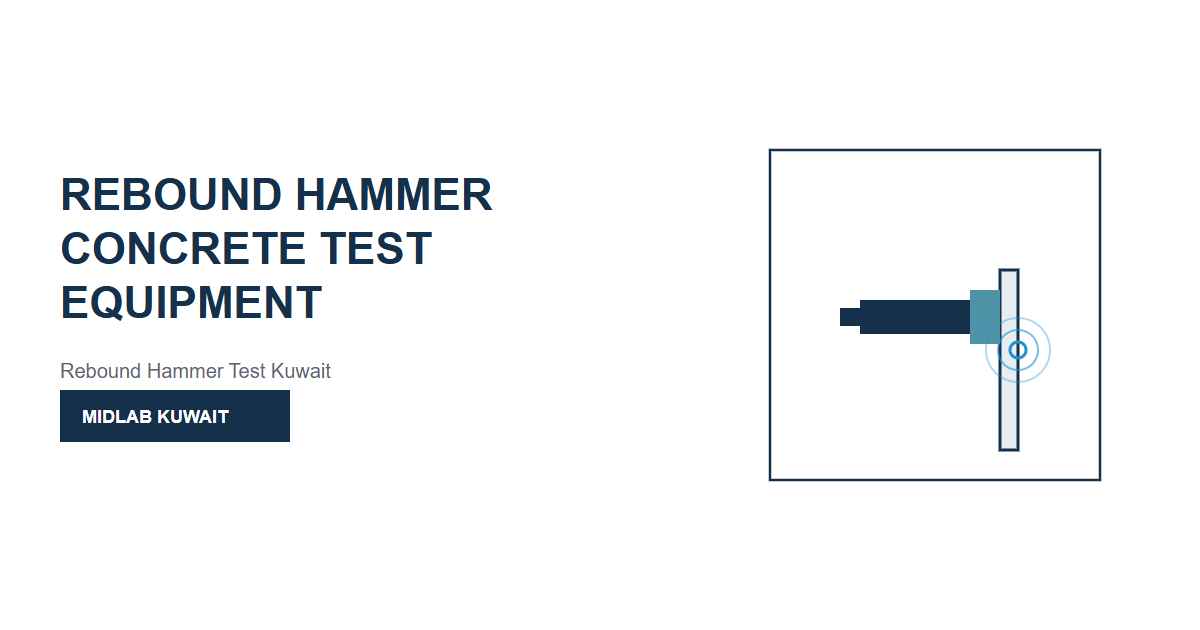
The rebound hammer test (ASTM C805, EN 12504-2) fires a spring-loaded mass against the concrete surface and measures how far it rebounds. Higher rebound numbers generally correlate with higher surface hardness and, indirectly, compressive strength. It is fast and non-destructive, making it ideal for screening large areas of a structure or comparing uniformity across a concrete pour in Kuwait.
Rebound Hammer Equipment MIDLAB Supplies in Kuwait
MIDLAB supplies Matest digital and analog rebound hammers, calibration anvils and correlation charts for construction quality-control teams across Kuwait.
Applications on Kuwait Projects
Rebound hammer surveys are widely used across Kuwait for rapid condition assessment of existing structures, car parks and precast elements, and for comparing concrete uniformity across a large pour before more targeted core sampling is carried out. Because the test is quick and requires no coring, it is well suited to large commercial and residential developments where many locations need to be screened efficiently.
Why Choose MIDLAB in Kuwait?
- Genuine Matest equipment, sourced directly from the manufacturer.
- Local technical support and nationwide delivery across Kuwait.
- Trusted by geotechnical, asphalt, concrete and steel testing laboratories.
Frequently Asked Questions
Can a rebound hammer replace a compression test?
No. A rebound hammer gives a fast, indirect surface-hardness indication and is best used for screening and uniformity checks, not as a replacement for compression testing of cast cylinders or cores for definitive strength values.
Does MIDLAB supply rebound hammers in Kuwait?
Yes. MIDLAB supplies genuine Matest rebound hammers in Kuwait, with nationwide delivery and technical support.
Does the rebound hammer need to be calibrated?
Yes. Rebound hammers should be regularly verified against a calibration anvil and correlated to core strength results for the specific concrete mix being tested, to keep estimates reliable.
Related guides: Non-Destructive Testing Equipment, Concrete Test Equipment.